
The four NiTi Brush models share one bristle (shape-memory nickel-titanium wire), one shaft diameter and one drive (implant motor, 20:1 reduction handpiece, 600–1,200 rpm under sterile saline). What differs is the head geometry and the shaft length, and therefore which exposed implant surface the head can reach. This page sets out the criteria HANS Korea uses to match a model to a defect. They are the manufacturer's selection criteria, not clinical findings, and the published studies do not report a rule for choosing a brush model; the choice is the clinician's decision at the time of surgery.
Five questions at the defect and the model each answer points to
| Question | What you see | Model |
|---|---|---|
| 1. Exposed threads | One thread exposed (initial stage) | NANO — pointed, bound tip for very targeted work |
| Two to three threads exposed (established) | POCKET — open head with access into the pocket | |
| More than three threads exposed (deep pocket) | OMEGA — wide, splayed head that folds around the thread | |
| 2. Pocket depth and room to work | Deep defect, little space at the bottom of the pocket | OMEGA — its wide opening angle reaches the threads at the bottom of deep pockets |
| Almost no space, minimal access | NANO | |
| 3. Posterior access | Molar region, narrow posterior site | POCKET SHORT — the POCKET head on a short shaft; same debridement performance as POCKET |
| 4. Mouth opening | Patient cannot open wide | POCKET SHORT |
| 5. Prosthesis | Prosthesis left in place; the exposed surface is visible and reachable | Any model whose head reaches the exposed surface; the shaft length and head width decide. See the note below. |
Thread criteria: NANO one thread, POCKET and POCKET SHORT two to three threads, OMEGA more than three threads (HANS Korea model criteria, as on the product page). Several models can be used in sequence on one implant where the defect is irregular; one published laboratory study describes NANO and POCKET used one after the other.1
The four models one image each, mounted in the handpiece
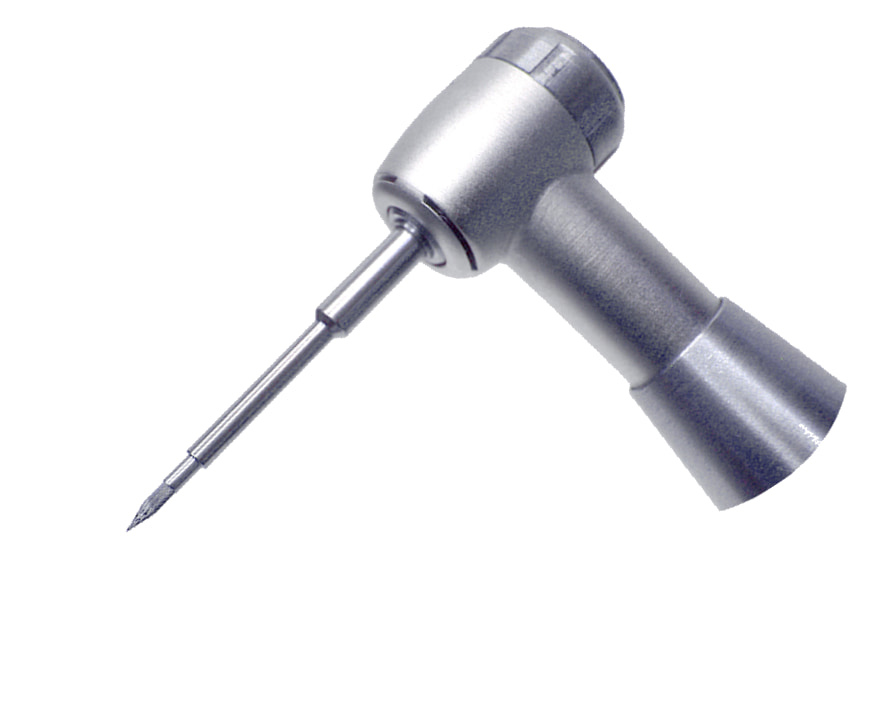
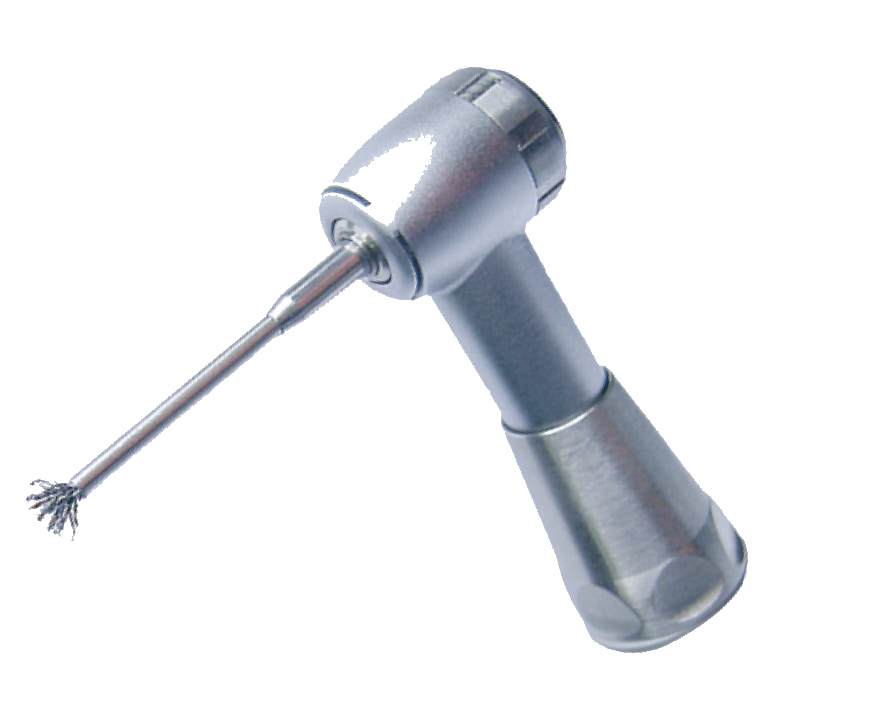
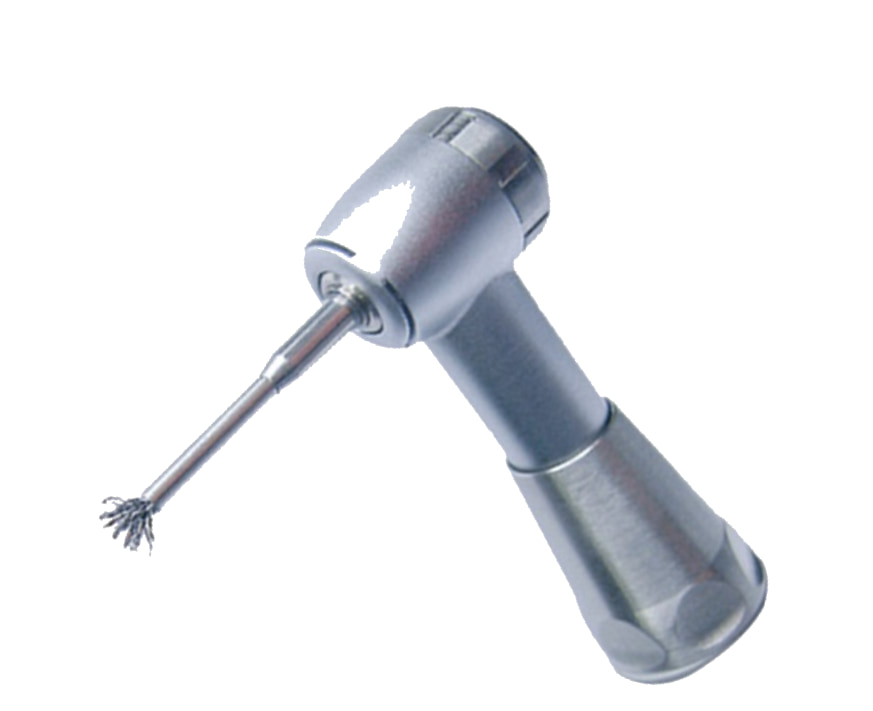
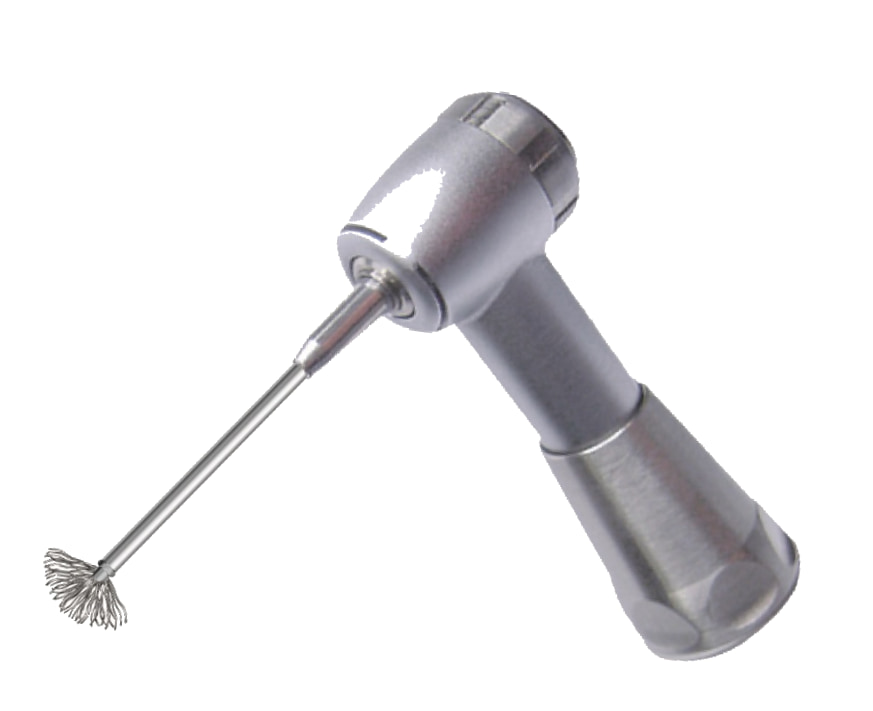
All four models: same nickel-titanium bristle, same shaft diameter, implant motor through a 20:1 reduction handpiece at 600–1,200 rpm, sterile saline irrigation throughout, supplied non-sterile, single use (Instructions for Use HKIFU-001, Rev. 07).2 The model name is marked on the shank.
With the prosthesis left in place
Where the brush head can reach the exposed implant surface and the operator can see it, debridement can be planned without dismantling the restoration. Several of HANS Korea's clinical cases, on video and in clinical photographs, were treated with the prosthesis left in place (clinical videos, clinical cases). They are individual cases, not a guarantee. Whether a prosthesis is removed or adjusted, and which head and shaft length can reach the surface under it, is decided by the treating clinician at the site.
Which models the published studies name
Where a publication on the Literature page states the model, it is quoted there: the NANO model in the multicentre trial of Derks et al. 2022, its 3-year report (Alibegovic et al. 2025) and the trials of Regidor et al. 2023 and 2026; the POCKET model in the flap-surgery arm of Malmqvist et al. 2025; the OMEGA model in the two cases of Babgi & Felemban 2024 and in the laboratory study of Kao et al. 2024; NANO and the former Micro model in the case series of Brincat et al. 2023.3 Most other publications say “NiTi brushes” without a model. None of them compared one model with another, and the outcomes they report belong to the whole surgical protocol, not to the brush or a model.
A short decision path
Raise the flap and count the exposed threads
One thread: NANO. Two to three: POCKET. More than three: OMEGA. The count is made after removal of granulation tissue, when the exposed surface is visible.
Check the access
Narrow posterior site or limited mouth opening with two to three threads exposed: POCKET SHORT instead of POCKET. Minimal space: NANO. Deep pocket with little room at the bottom: OMEGA.
Check what the head must pass
Prosthesis left in place, neighbouring teeth, the defect wall: choose the head and shaft that reach the exposed surface you can see. Several models may be needed on one implant.
Set the drive before brushing
Implant motor, 20:1 reduction handpiece, 600–1,200 rpm at the brush, sterile saline running for the whole brushing time; brush sterilised before use and discarded after the case (IFU).2
The choice is the clinician's decision
These criteria are HANS Korea's guidance for matching head geometry to the defect. They are not a treatment protocol, they do not replace the Instructions for Use, and they do not imply that any model or any brush gives a better clinical result. Regulatory clearance and availability of individual models differ by country.
References
- Liu X, Deng S, Xie J, Xu C, Huang Z, Huang B, Chen Z, Chen S. 2-DG regulates immune imbalance on the titanium surface after debridement. International Journal of Molecular Sciences 2023;24(14):11431 — discs were debrided with NANO and POCKET brushes in sequence, 800 rpm, 40 s each (in vitro). DOI: 10.3390/ijms241411431
- HANS KOREA CO.,Ltd. NiTi Brush Instructions for Use, document HKIFU-001, Rev. 07 (22 May 2023). Download (PDF, multilingual)
- Model names as quoted in the instrument lines of the Literature page: Derks et al. 2022 (10.1111/clr.13972); Alibegovic et al. 2025 (10.1111/clr.14393); Regidor et al. 2023 (10.1111/jcpe.13796); Regidor et al. 2026 (10.1111/clr.70152); Malmqvist et al. 2025 (10.1002/JPER.24-0683); Babgi & Felemban 2024 (10.54940/ms75920247); Kao et al. 2024 (10.3390/dj12050123); Brincat et al. 2023 (10.3390/app13127224).
HANS Korea is not the publisher of these works and has no commercial relationship with the journals. Listing a publication does not imply endorsement by its authors. See the legal notice.